In this article
You built a folding cart that’s supposed to open with one hand. To test it, you ask a friend to unfold it while holding a cup of coffee. On earlier versions, the latch would stick and you’d have to reach over to help. This time your friend lifts the handle and the latch clicks into place. You’ve finally fixed the part that kept jamming.
Later that afternoon a manufacturer emails. They can give you a price on fifty carts. Could you send the side view of the latch?
You attach the drawing. You sit there a minute.
Pride after a long stretch of solitary work. A first-time hand-tool inventor spent two years fitting prototype work around a demanding day job. After about AU$10,000 of their own money and several versions, they had a tool they were proud of. Now they wanted to make the first 20 to 50 units, and that money would come out of the same pocket. Read the inventor’s account.
Uncertainty about what to do first. One consumer-product inventor wanted to know whether a factory could make the product before spending thousands on a patent. Finding that out meant showing a manufacturer the design. Which expense, and which conversation, came first? Read the inventor’s question.
You can file a U.S. provisional patent application while the product is still changing. The reason to consider filing now is that you know how the important part works and may soon have to show it to someone. The early date can benefit a later patent claim only if the application you actually file adequately describes and teaches the invention in that claim. For the person deciding whether to send the drawing, the immediate question is quite manageable. What does that side view tell the factory, and where have you explained it in the draft? USPTO guide to provisional applications.
The angle everybody at the company knew about
The inventor, Cox, developed a drill bit for boring through rock. A small angle between the bit and its housing mattered. The company filed a provisional application. It included two drawings. It discussed drilling geometry in considerable detail. A reader could learn quite a bit about how this particular piece of equipment broke up rock and still come away unable to tell how the bit sat against the housing.
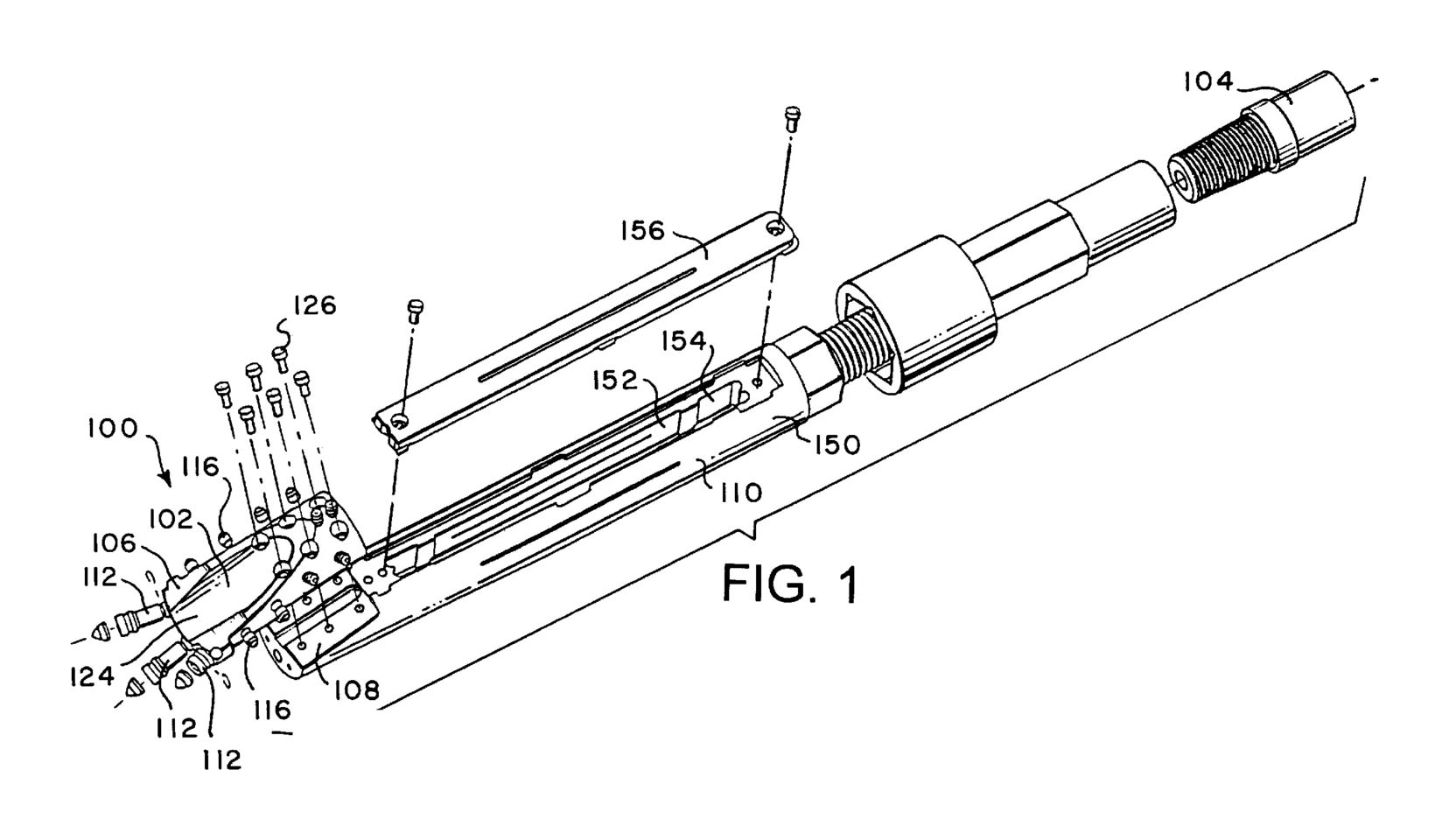
An exploded view of the bit and sonde housing, from FIG. 1 of the later patent, U.S. Patent No. 5,899,283. According to the court, both drawings in the provisional also showed the bit detached from its housing.
Years later, there was occasion to ask precisely that question, in court, where it is expensive to discover that you wish you had drawn something from the side. Even the employee responsible for the company’s research and development couldn’t tell from the provisional drawings whether the relevant edges of the bit extended beyond the housing. The later patent described the angle. The Federal Circuit held that the provisional hadn’t adequately disclosed it. Without that earlier filing date, the company’s own commercial offers were old enough to invalidate the patent under the law then in force. New Railhead Manufacturing v. Vermeer, Part III.
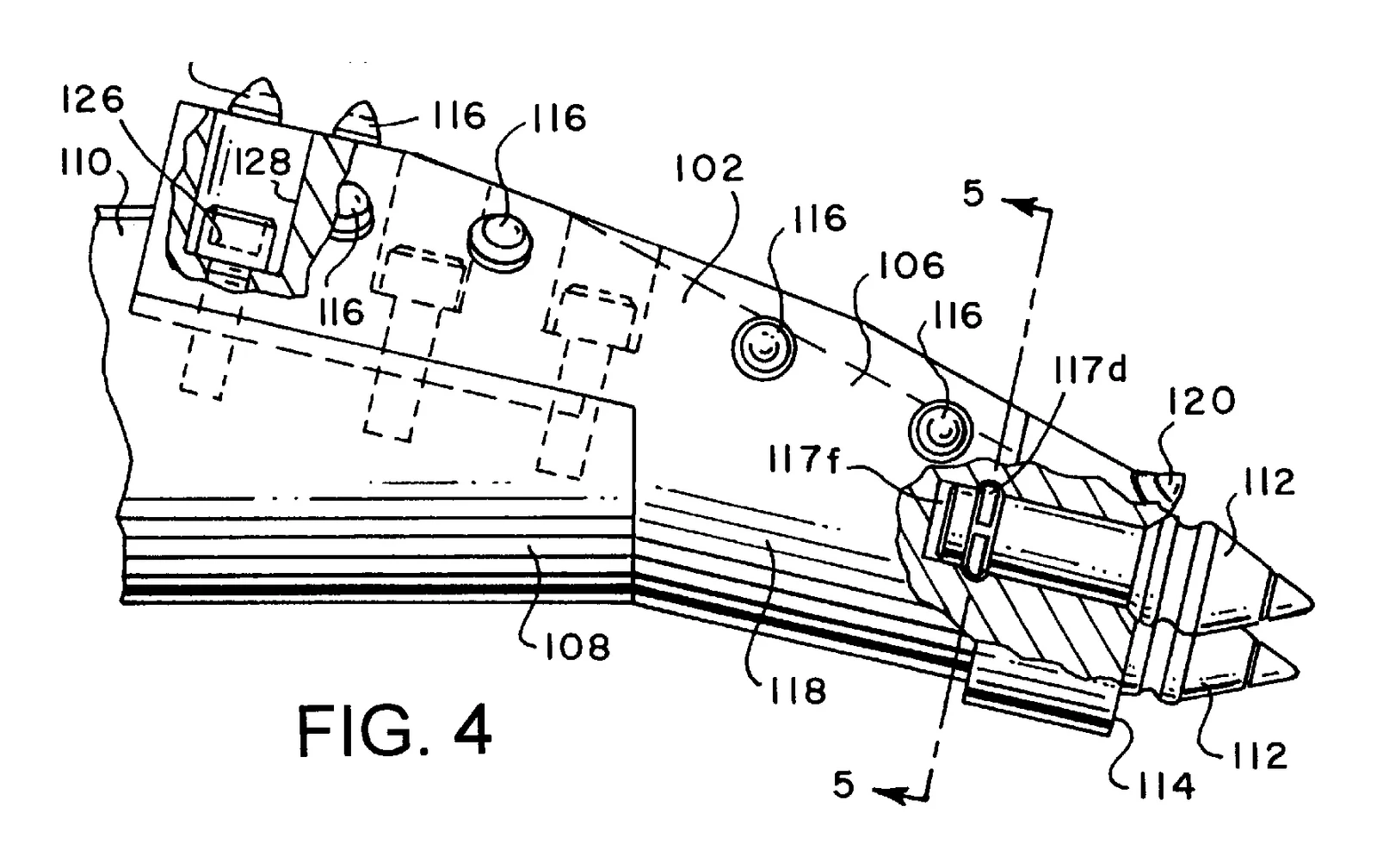
The side view, from FIG. 4 of the same patent. The patent says the bit body is angled about 15 degrees from the housing, “as best shown in Fig. 4.” Neither provisional drawing showed the bit attached.
One reason to linger over the drill bit is that Cox had already done the hard thing. He had figured out how to drill the rock. The omission was the sort a knowledgeable person is especially well equipped to make. Once you know how two pieces fit together, it takes a small act of imagination to look at your own drawing and see what a stranger sees.
Try it. Put the prototype in a drawer. Hand the draft to someone who understands the field. Ask them to sketch how the two critical parts fit, or to walk you through the sequence that makes them work. If you have to step in to explain something, write down what you just told them. It belongs in the draft.
How finished does the design have to be?
Doubt about which version to file. An inventor working with a design firm knew the idea would stay the same. The materials and the shape of the finished product were still up in the air. Waiting a few weeks might settle both questions, but conversations with prospective investors had already begun. Read the inventor’s account.
A production model is optional. So is a working prototype. Formal claims are optional in a U.S. provisional, too. What carries the weight later is a written description showing what you had worked out and teaching somebody skilled in the field how to make and use the claimed invention without undue experimentation. Include the drawings necessary to understand it when you file. The USPTO sends a filing receipt without examining the provisional on its merits, so this is one piece of writing for which the arrival of a receipt tells you very little about how well you wrote it. 35 U.S.C. § 112 · USPTO filing guidance
Take the folding cart. The prototype has a hardware-store spring and an aluminum housing because the hardware store was open and you had a block of aluminum. When the handle opens fully, the spring drives a pin into a recess. Squeezing the trigger retracts the pin so the hinge can turn. Suppose the discovery that finally stopped the latch from jamming was that the pin had to clear the recess before the hinge began to turn. Give that discovery a sentence. Give it the side view. Someone reading the words “spring-loaded latch” could spend a perfectly miserable Saturday rediscovering the detail you left out.
Now consider three changes you might have in mind:
| What might change | What you can usefully write today |
|---|---|
| The factory wants to mold the housing. | Identify the surfaces that guide the pin and keep it aligned. If a molded housing can preserve those relationships, explain how. |
| You have worked out a cable-operated trigger. | Sketch the cable route and its two attachment points. Explain how far the pin must travel and what pulls it back. Say whether you’ve built this version. |
| Someday you’d like the cart to unlock itself when empty. | Record what you know about detecting the load and releasing the latch. If the entire design currently consists of the word “automatic,” keep the question in your development notes. You’ll want a much better answer before relying on a filing date for that feature. |
Surprise when the sample comes back different. One founder opened a shipment and found a good-looking sample that differed from the drawings. The supplier had changed several details to make them easier to manufacture consistently. What upset the founder was learning about those decisions only after opening the box. Read the founder’s account.
Ask the shop to mark up the original drawing with what it changed, why, and who worked it out. If somebody at the factory got the latch working by moving the guide three millimeters, the CAD file on your laptop and the cart in your hands now tell two different stories. You want to know that while you can still ask the person who moved the guide.
The manufacturer wants my drawings. How much do I show?
Unease about who hears it next. The inventor working with the design firm trusted the investors they’d spoken to. What worried them was the next conversation. An investor might mention the idea to a colleague, who might pass it along to somebody the inventor had never met. Read the inventor’s account.
Start with the question you need the other person to answer. A warehouse manager can tell you how often drivers fold carts with one hand without ever seeing the inside of yours. A toolmaker quoting the pin guide probably needs its dimensions. A buyer asking for fifty finished units has moved the conversation somewhere else again.
| The conversation | What to do before it |
|---|---|
| Getting a manufacturing estimate | Ask which views the shop needs. Settle confidentiality and permitted use before sending sensitive files. Keep the version you sent and the email explaining what you asked the shop to do. |
| Lending a prototype to a tester | Write down the technical question, who will use the sample, under what conditions, and when it comes back. A controlled test of whether the pin wears out serves a different purpose from finding out whether customers like the cart. |
| Pitching a buyer who declines an NDA | Decide what the buyer needs to evaluate today. If a demonstration of one-handed operation will do, the latch drawing can stay on your laptop. If they need a sample to take away, review what it reveals against your filing. |
| Taking preorders or launching a campaign | Review the page, video, price, order terms, and version on offer before launch. The camera angle and the offer to sell can raise separate patent questions. |
An NDA can do real work here. Read what the recipient agrees to keep confidential, what they can use it for, and whom they can involve. Then look separately at the transaction. In Helsinn v. Teva, the existence of a commercial deal was public, while the relevant drug dosage remained confidential. The Supreme Court held that a sale to a buyer obliged to keep the invention confidential could still put the invention “on sale” under U.S. patent law. Asking what a tool would cost and offering to deliver a thousand units are different events, even if both emails have the same subject line. Supreme Court opinion in Helsinn · USPTO guidance on experimental use and market testing
Once you actually file, you can use patent pending for the invention while the application is pending. Those words accurately report an event. They don’t give you an enforceable right to stop someone from copying the cart. If a patent issues, its claims define what you can exclude others from doing. USPTO filing guide · USPTO guide to patent rights
What if I have to pay to file again?
Fear of paying for the same work twice. The inventor waiting on the design firm could afford help with a filing. What they couldn’t budget for was paying to draft it now and paying again when the design was final. Read the inventor’s question.
Put the application as filed beside the new design. Changing the supplier of a standard spring may leave the disclosed mechanism intact. Replacing the pin assembly with a sensor that releases the lock when the cart is empty poses a more interesting question. Where does the first application explain how the sensor and the lock cooperate? If you can find the passage, you and your patent attorney have something concrete to assess. If you can’t, and the improvement is something you’d care about a competitor copying, consider a second provisional before showing or offering the upgraded cart. Describe the whole arrangement well enough to teach how the improvement works in the product. New technical material cannot be added retroactively to the first filing. USPTO provisional application guidance · USPTO domestic benefit requirements
Here’s what that looks like on a calendar.
- March 10, 2027. You file a provisional adequately describing the mechanical latch. A later claim to that mechanism may get the March date.
- June 15, 2027. Before demonstrating the upgrade, you file a second provisional that, for the first time, adequately describes the sensor operating with the lock. A later claim requiring that combination may get the June date.
- By March 10, 2028. On the ordinary U.S. timetable, file the nonprovisional and specifically claim the benefit of both provisionals to preserve the opportunity to rely on both dates. Plan any corresponding foreign or Patent Cooperation Treaty filings against the first anniversary as well. USPTO domestic benefit requirements · WIPO PCT Applicant’s Guide
Watch out for the meeting in May. Everybody remembers the celebratory email in March saying the cart was patent pending. Somebody brings the newest cart because of course you bring the nicest one to a buyer meeting. That’s the one with the sensor. Which cart did you file on?
I’ve already shown a few people. What now?
Start with your sent mail. “I showed it to a buyer last spring” is how human beings remember things. The email can give you the day, the attachment, the people copied, and whether the buyer asked for a price or placed an order. Save the deck or video as it appeared then, any confidentiality terms, and a note about what you demonstrated in person. Take that chronology to a patent attorney promptly, along with the countries where you may want protection.
There are two different years people have in mind when they say you have a year. Before filing, U.S. law provides exceptions for certain inventor-originated disclosures made one year or less before the effective filing date of the claimed invention. Who disclosed what, when, and what others independently disclosed can all matter. In Europe, your own prefiling public disclosure can defeat novelty, subject to narrow exceptions. This is why the attachment in that old email is worth finding. 35 U.S.C. § 102 · USPTO grace-period guidance · European Patent Office guide, § 3.3
After filing, the provisional starts the ordinary 12-month period to file a later application claiming its benefit. Even an inventor who showed the product to absolutely nobody has this deadline. And meeting it won’t supply a missing explanation of how the bit sat against its housing. USPTO filing timetable.
Twenty minutes before you send the drawing
- Draw the moment it works. Show the latch just before and just after the pin clears. For software, take one actual input and follow it through the operations that produce the result.
- Write down the failure you finally fixed. What jammed, slipped, or returned the wrong answer? What did you change? This is often the paragraph you’re most qualified to write and most inclined to skip.
- Explain one alternative you understand. Draw it, identify what else would have to change, and say which version you tested.
- Open the actual attachment. Compare it with your draft or your filed application. Can you point to the passage or figure that teaches the important thing the recipient is about to learn?
For a wider look before you file, the free provisional patent readiness check asks eight quick questions, including whether a launch, sale, or other public disclosure is coming up.
If you can explain the mechanism aloud but find yourself writing “an innovative solution” the minute you open a blank document, record the explanation. Tell it the way you’d tell the person at the shop. You can bring that transcript or a written description to Patent Pending Made Simple. Its attorney-designed software helps turn those details into a provisional application draft you can review, with self-filing and optional review and filing support available. A past sale, a question about foreign rights, or a judgment about what an earlier filing supports belongs in a conversation with a patent attorney. Explore Patent Pending Made Simple.
Start the recording with the part about the pin. You remember exactly what it used to catch on.